

“Taoka are potent connectors travelling across space, time and generations. Imbued with the whakapapa of our tīpuna, they connect our past, present and future. When taoka are gifted, they often return, generations later, to the hands of their descendants. While the colonial project with its attendant ethnographers, collectors and museums has disrupted this dynamic, sometimes taoka speak for themselves. They manage to be heard through the glass case, or in this case the shoebox – and return home.”
Helen Brown, WORD, September 2026
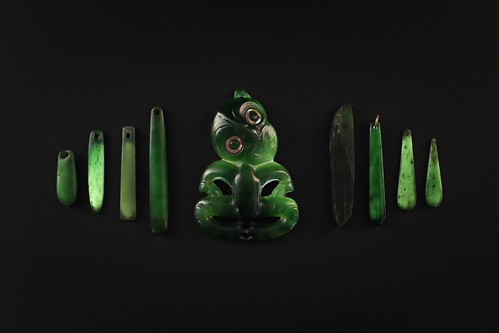
I first encountered the Shortland Pounamu the week after the third reading of the Ngāi Tahu Settlement Act in 1998, when it was proudly displayed at the then-tribal headquarters on Hereford Street. Comprising of nine Kaki (pounamu pendants) and six beads, it features a beautiful hei tiki at the heart of the collection. I have always wondered about the collection, how it got its name, and its history, but time was never a friend, and so they became another item on the ‘to do’ list. That is until WORD Christchurch Festival 2026 hosted the Shortland Pounamu lunchtime lecture at Tūranga on Friday 4 September.

Presenting to a near-capacity audience, Kāi Tahu Archive panellists and historians shared the story of the Shortland Pounamu and its namesake, Edward Shortland, whom Tā Tipene O’Regan describes as a friend of Kāi Tahu. Brought to WORD by the University of Canterbury Ngai Tahu Research Centre, the one-hour lecture provided full historical context for the collection and the man it was named after, as well as the journey the pounamu underwent before returning home.

Presenting first, Professor Mike Stevens provided an in-depth insight into Edward Shortland, the man, the scholar, the administrator, but most importantly, the humanitarian. With the aid of Professor Athol Anderson's notes, Stevens traced Shortland's life from his birth in Devon, England, in 1812 to his death in Plymouth, England, in 1893. Stevens’s presentation focused on Shortland's work as Sub-Protector of Aborigines in Te Waipounamu, predominantly in the Murihiku/Southland and Otago areas from 1843 to 1844. During his travels, Shortland closely observed daily life and met with Kāi Tahu rakatira. He later published these observations as an account of his travels, The Southern Districts of New Zealand, in 1851. Shortland's observations became important evidence used by Kāi Tahu during Te Kerēme.

The Southern Districts of New Zealand
Next to present was Ngāi Tahu Archives Manager, Takerei Norton, who retraced Shortland's travels in Te Waipounamu using Kā Huru Manu, the online Kāi Tahu cultural mapping atlas. Norton also stressed Shortland's strong relationship with Kāi Tahu during his time in Te Waipounamu and the importance of the information he recorded, much of which is source material for Kā Huru Manu and remains a reference point for historians.

The last to present was Ngāi Tahu Archives Principal Advisor and Senior Researcher Helen Brown, who provided the collection's historical context, particularly regarding the Hei Tiki. While the provenance of the nine kaki is unknown and the beads are not of New Zealand stone, the hei tiki is believed to have been gifted to Shortland circa 1840. Examination of the hei tiki indicates that it is of southern origin, with Brown noting :
“the raised tab for the suspension hole at the top of the head is a stylistic feature indicative of hei tiki made in Te Waipounamu. Fashioned from stone tools prior to settler contact, the hei tiki exhibits very high-quality artisanship.”
Pounamu experts describe the stone as flawless, and the lack of wear on the tiki suggests it was likely displayed rather than worn. Brown notes that little is known about the collection's movements until Geoffrey Diss of Cumbria, England, purchased it in the 1950s as part of an estate sale. For the next 25 years it sat with other ‘curiosities’ in a shoebox in his attic until 1976 when its journey home began. It would be another 21 years before the collection was repatriated to Te Waipounamu and into the care of Kāi Tahu. Initiated in 1983 by a letter to the New Zealand High Commissioner in London, Diss wrote:
“The greenstone has just come to my notice again after lying neglected in a cupboard since 1976. The ‘tiki’ must surely feel it is amongst strangers. My wife and I feel it is time it returned home. Would you agree? If you do, we would be happy to donate the tiki and greenstone to your Excellency, on the understanding that they would be passed on to some Māori organisation or museum who would treasure them for the future.” (Brown, 2026)
and the rest, as they say, is history.

The Shortland pounamu is currently on display as part of the exhibition of the Kāi Tahu deeds, Kā Whakatauraki: The Promises at Te Puna o Waiwhetū Christchurch Art Gallery, until February 2027. A collection of pounamu featuring a beautiful hei tiki fashioned with stone tools from a flawless piece of pounamu, likely pre-1840s. As Brown notes:
“[the collection is] made even more significant by its association with Shortland, whose compassionate, progressive and humanitarian regard for Kāi Tahu and Māori katoa was rare amongst the early colonial administrators.”
It is because of these qualities that Tā Tipene O’Regan refers to Edward Shortland and other non-Māori with similar virtues intertwined in Kāi Tahu history as ‘a friend of Ngāi Tahu.’

NOTE: While The Southern Districts of New Zealand is available from Christchurch City Libraries, it can also be purchased from Te Rūnanga o Ngāi Tahu Bookshop
Photos
View photos of the Shortland Pounamu event
More WORD Christchurch
- Our WORD Christchurch 2026 page: Picks of the festivals, reportage and more!
- Visit the WORD Christchurch website
- Follow WORDchch on Instagram
- Follow @WORDchch on Tik Tok
- Like WORD Christchurch on Facebook

Add a comment to: Shortland Pounamu: WORD Christchurch Festival 2026