

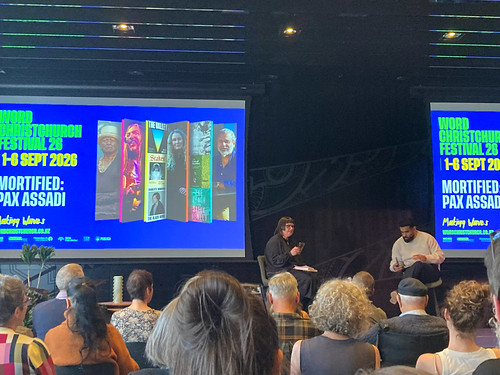
Since humans can remember there's been discussion and debate over what it means to be human, and as with all the other big existential questions I don't think we've ever managed to come to a consensus. After Pax Assadi's WORD event on Friday, though, I've decided I'm going with host pip adam's answer if I get asked my thoughts:
To be human is to be exposed, or embarrassed.
I'm aware there could be a conversation here about whether animals feel embarrassment - I'm specifically thinking of all those 'guilty dog' videos, as I'm convinced there is an element of humiliation or embarrassment there - but I'm not a psychologist or philosopher, so I'll stick with what I know, and get back to talking about books...
If his name doesn't ring a bell, Pax Assadi is the author of the memoir Mortified, has developed a collection of stand-up bits based on awkward personal experiences, created Raised by Refugees, opens a new window (a tv show all about trying to fit in with the crowd, opens a new window, and has been a contestant on TV games shows. I was already reading Mortified when I learnt he was coming to WORD Christchurch, opens a new window for a kōrero, so I was keen to head along - I don't know about you, but to me that earlier list of achievements sounds like the CV of someone who knows a bit about being embarrassed and laughing at themselves, so I had the feeling this talk had the potential to be a very entertaining afternoon. And boy, was I right!

Right from the get-go, pip and Pax let the full Tūranga audience know that the hour would be a relaxed, informal affair (like Pax himself), and immediately got into discussing the three stand out themes of the evening:
- the difference between writing and creating for stand-up, the screen, and the page;
- navigating difficult situations;
- poop and farts.
From pip's observation that 'stand-up is the king of the storytelling form', Pax shared a little about writing the draft of his book after stand-up began to feel 'too safe'. After 14 years, his experience in stand-up meant he was no longer getting the same thrill as when starting out, when he was unsure of what he was doing, or of how what he said would be received. Looking to recreate those feelings he went searching for a new creative challenge...
Writing Mortified has provided many opportunities for him to feel that uncertainty, thrill, and creative challenge that he had been seeking:
- When choosing stories, writers are trying to write something for everyone when we all have different personalities and experiences. We are all the same in that we are human, though, so even if someone doesn't have a father from the same culture, we all have a similar idea of how bad our behaviour would have to be to get a father to (for example) start smoking again after they've gone to the trouble of quitting... Writers need to find those similarities between us so we can all find something to relate to.
- Writing for the screen is dialogued-based. Characters in shows can convey info through their words, actions, and mannerisms, but this isn't the case in books. Writing for the page is about the details, and so authors are trying to balance the need to 'say more' in their writing while simultaneously knowing readers have increasingly shorth attention spans because of all the online videos we watch.
- It takes courage to put out a piece of work that will be going out in the world forever ... especially if it's a book full of embarrassing stories about yourself that you can't take back! If people don't like the book you've written, it will be on the shelves for years, and the whole time it's out there people can tell you how bad a book it is.
Without going into details - you'll have to read the book for that! The conversation moved to how Pax deals with awkward and nuanced situations in his book, and in real life. This was a topic that came up again in the Q&A sections, and Pax's advice was to aim to be a good person, to be open to learning, and to centre empathy in that moment. People will bring their own perspective to whatever is happening, and approaching a potentially loaded scenario with empathy will allow healthy debate and discussion, regardless of various participants views of the topic.
Culture is another factor to consider when discussing delicate topics, and deciding when (or if!) to approach a topic, and how exactly to do so. As an example of this, the audience heard about a chapter where Pax recounts being assaulted by a police officer, a scenario he acknowledged many New Zealanders would think of as "something that happens in America". We heard how Pax had tried to include this incident in a stand-up routine, but it didn't work because "New Zealanders are not very good at laughing" on a good day, and when that was combined with them hearing this story had happened here in New Zealand, they felt too uncomfortable for him to be able to pull them out of their uncomfortable state enough to laugh with him.
Which brings us to poop and farts...
Cultural differences aside, Pax's take on comedy and humour is that it's about the unexpected. When the audience thinks a story is heading towards one outcome, and then it gets a different punchline, then that's good comedy. And poop and farts are funny, because 'they're the biological equivalent of a surprise punchline - they're the body's surprise!'
Ok, fine ... number three in that earlier should probably say 'humour' rather than 'poop and farts' specifically, but apparently one of the ways of writing humour is to write two expected things and then something unexpected for the third, so I'm giving it a go 😉
I really enjoyed reading Mortified, and this was a perfect companion event to hear more about the author and the events that inspired it.
... And in case you were wondering, that would be a yes to both...


Photos
More WORD Christchurch
- Our WORD Christchurch 2026 page: Picks of the festivals, reportage and more!
- Visit the WORD Christchurch website
- Follow WORDchch on Instagram
- Follow @WORDchch on Tik Tok
- Like WORD Christchurch on Facebook

Add a comment to: Why do I laugh when someone embarrasses themselves? Am I just pleased it’s not me, or is it actually funny?: Pax Assadi