
Friday 15 August 2025 marks eighty years since the final surrender of Japan and the end to the Second World War. It's important to think about what this day meant to people. The end of the war in the Pacific saw momentous changes that reverberate to this day, not least among them the first (and hopefully only) combat use of nuclear weapons. It also reshaped the Asia-Pacific region, hastening decolonisation in South-East Asia and the Pacific, Australia and New Zealand now looking to the United States for security, and the emergence of a democratic Japan.
New Zealand’s war effort in the Pacific
New Zealand was further away from Japanese-held territory than Australia, but Japan’s expansion still threatened New Zealand – especially if Japanese forces were to advance further south and east into the Pacific. While the main part of New Zealand’s war effort remained focused on the war in Europe (unlike our Australian allies), New Zealanders did serve in the Pacific Theatre. The 3rd New Zealand Division served in the Solomons campaign during 1943 and 1944, fighting on Vella Lavella, the Treasury Islands, and the Green Islands.
New Zealand-crewed ships served right through the Pacific War including HMNZS Achilles, Leander, and Gambia. The Royal New Zealand Air Force served throughout the Pacific War in a variety of roles supporting the Allied advances, especially around the Solomons.

At home, over one hundred thousand men were mobilised and trained in the Home Guard (including my great-grandfather who was medically unfit for overseas service), intended to help defend New Zealand should it ever come under direct attack by the Japanese. The Pacific War also saw thousands of American personnel deployed in New Zealand, creating opportunities for building new relationships and experiences, but also creating tensions and clashes over cultural differences and American attitudes to Māori.
Clarence Walker collection - Canterbury Stories
Canterbury Stories has a wonderful collection of photos from Clarence Walker, who served on HMNZS Gambia, and visited Japan at the surrender in 1945. Explore the Clarence Walker Collection

The Japanese surrender
By 1945, the war was clearly going the Allies’ way, with Allied forces advancing towards Japan through the central and south-west Pacific, and in south-east Asia. American bombers were devastating Japanese cities from the air and US submarines were blockading Japan from vital imported food supplies. Despite this, Japanese forces continued to resist fiercely with the fights for the Philippines, Iwo Jima and Okinawa in 1945 being particularly bloody, and the increased use of kamikaze attacks showing both desperation and the willingness to continue the fight. All of this was a harbinger of what an invasion of Japan might look like. The planning for this involved New Zealand, with New Zealand forces expected to be a part of the landing forces for Operation Olympic in 1946.

The surrender itself was a process – the Allies had agreed on a policy of unconditional surrender (no negotiations) at the Casablanca and Cairo Conferences in 1943, and at the end of the Potsdam Conference in June 1945, the Potsdam Declaration was issued stating how Japan was expected to surrender.
Japan’s response was to continue the war but the combination of the two atomic attacks on Hiroshima and Nagasaki on 6 and 9 August 1945, and the Soviet Union joining the war and invading Manchuria on 9 August, finally convinced the Japanese to surrender – in Emperor Hirohito’s words “endur[e] the unendurable”, communicating this to the Allies on 14 August. The next day, on 15 August, the surrender was official. Emperor Hirohito’s radio message to the Japanese people (the first time most Japanese had ever heard his voice) announced:
“[T]he war situation has developed not necessarily to Japan's advantage, while the general trends of the world have all turned against her interest.”
Even though VJ Day (Victory over Japan Day) was on 15 August, the official surrender ceremony only occurred later on 2 September. On the decks of the US battleship USS Missouri, the Emperor and Allied representatives – including Air Vice Marshal Leonard M. Isitt for New Zealand – signed the Japanese Instrument of Surrender.


VJ Day
The announcement of the Japanese surrender and “VJ Day” saw celebrations across New Zealand on and after 15 August at 11am. Plans for VJ Day when it happened were already in place for Christchurch but had to be quickly adjusted for 15 August as it was still winter, Prime Minister Peter Fraser made clear that New Zealand would not wait for the formal surrender to celebrate, and for two days public holiday on the 15th and 16th.
There was to be an official thanksgiving service on the first day with “bands leading community singing” as well as “the ringing of bells” and “the blowing of whistles and sirens”, and a victory march in the city on the second day from Latimer Square to North Hagley Park along with bands, military displays, the “release of 1000 pigeons symbolising the dawn of freedom and peace” and an artillery salute with the afternoon, and community singing and dancing in the evening, with a coloured water display and fireworks at Victoria Lake, ending with the lighting of a huge victory bonfire.


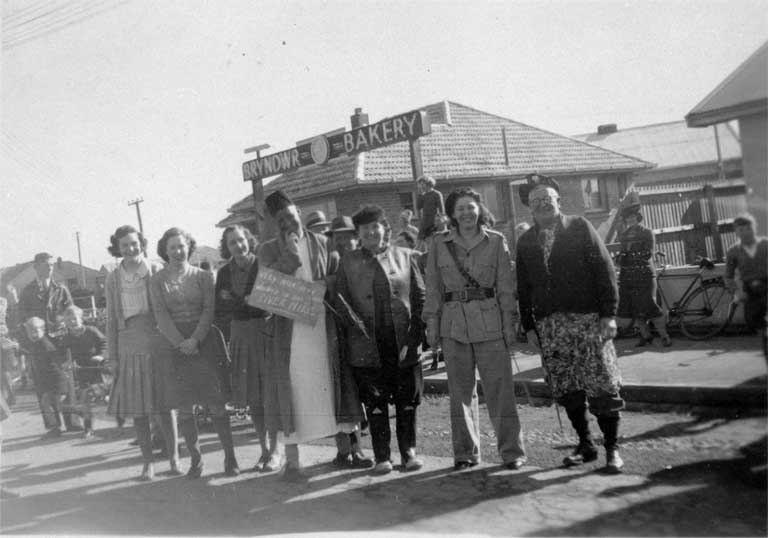
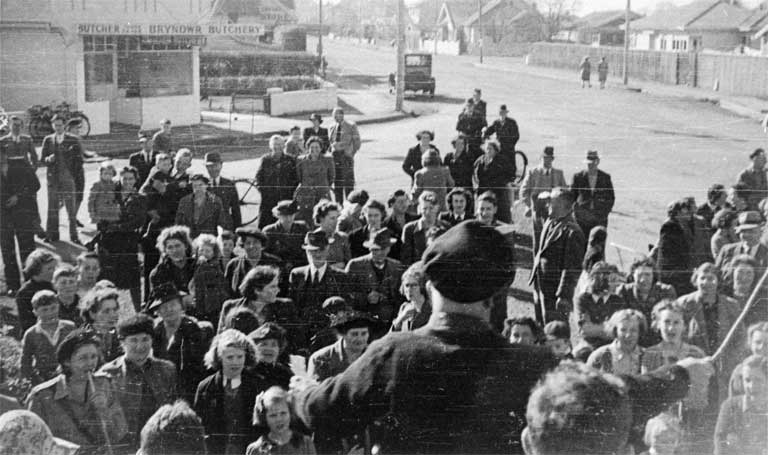
15 August 1945
At the thanksgiving ceremony at Lancaster Park on the afternoon of the 15th, 6,000 people attended, and many more attended services across Christchurch. People started celebrating themselves before the official marches, with “bunting adorned and flag-bedecked buildings, streamers, gaily coloured lights, several bands, and groups of revellers singing and dancing in the streets and in shop entrances provided the carnival atmosphere they needed.” The war was finally over, and “[t]he mass of the people wanted to, and did, release emotions pent up for almost six years of war.”


The descriptions of the day are really vivid – paper thrown from the Post Office in the Square and other buildings, whistles, car horns, and radios blaring. Everything began to close at noon and celebrations intensified.
“By 2:30pm, thousands of people had gathered in Cathedral Square and in the near streets. Some danced, and some sang.”
“A piano on a platform in Cathedral [S]quare was punished for some time in vain efforts to make it heard while some revellers on the platform performed hakas and others danced.”
“Victory “champagne” was freely offered by the many who bore familiar brown quart bottles, and the offers were as freely accepted.”
The celebrations continued into the evening and night, with a “spirit of carnival”, and thousands danced in the Square near a loudspeaker by the Post Office. By 11pm a crowd of 3000 was still in the Square as the last trams were leaving for the night.
Despite all this, the reports were that crowds were well behaved compared to VE Day, where they were apparently more “boisterous” and left more bottles littered around.

The march and ceremony on 16 August 1945
The official march and ceremonies in Hagley Park on 16 August 1945 were also lively.
“Huge crowds came to town...All suburban Christchurch appeared to have arrived in the central area.”
“Those who had shared the great demonstration of joy [in 1918 and 1919] ...made comparisons, the 1945 celebration was in every way greater than anything they had witnessed in the city”
The march saw banners and bands parading in force. The local Chinese community marched with a display to great applause “a response to their evident joy and partly a tribute to China as a true, faithful, indomitable ally.”
The march proceeded from Latimer Square through the Bridge of Remembrance to Hagley Park, with soldiers and veterans marching across the Bridge.
The parade was large enough that it took 20 minutes to pass, and the further it continued, the more the crowds joined in.
“With less than a mile from Latimer [S]quare, one vehicle was about a quarter of a mile behind. Nobody card. It was the people’s day, and they enjoyed it.”

At North Hagley Park, “a crowd described as probably the largest ever to have assembled in Christchurch, and possibly New Zealand” converged. Around a speaking platform on a motor truck, the crowd “covered an area from the Armagh [S]treet gates to the football and tennis pavilions, and several hundred yards across.”
At 2:15pm, the official speeches began with the Deputy Mayor of Christchurch (M. E. Lyons), the Primate of New Zealand Archbishop West-Watson (head of the Anglican Church), and Dan Sullivan the MP for the Avon Electorate (1919-47) and government minister.
The Deputy Mayor encouraged people to “relax and rejoice” and paid tribute to New Zealand’s forces, saying “We have had a glorious victory. It imposes on us a tremendous responsibility to promote the welfare not only of the British Empire but of all countries.”
Archbishop West-Waston looked to the future – towards a world “where man can trust his neighbour’s word, and where man thinks more of what he puts into the world than what he takes out of it. We know the sort of world we want. That is going to cost, like the war, blood and toil, and sweat and tears.”
Minister Sullivan emphasised the size of the crowd, paid tribute to those who had served and died, and New Zealand’s allies. He also looked to the future - “the people, with the same determination as shown in war, must set about in rebuilding shattered civili[z]ation and building a new world....[hoping] the angel of peace would touch the hearts of all mankind so that there might be enduring and universal peace and goodwill.”
After the speeches, a 21-gun salute was fired with artillery, the national anthem [God Save the King] played, and a brief silence was observed. Afterwards, much of the crowd remained for some time “for community”.
Overall, it was reported that despite the huge crowds, everything had “gone off wonderfully well”, with the crowds being “good natured” and “easily controlled” according to the Police Superintendent.

There were similar celebrations across the country on the days after VJ Day – an outburst of spontaneous celebrations after the surrender announcement at 11am on 15 August 1945, and formal thanksgiving ceremonies and processions through the cities and towns of Aotearoa.
After VJ Day
Christchurch and New Zealand stayed connected to events after the surrender. New Zealand personnel were selected to join the British Commonwealth Occupation Force, which had responsibility for the southern end of Honshu. “Jayforce” was deployed in Yamaguchi Prefecture from 1946 to 1948 and more than 12,000 New Zealanders served in Jayforce.
New Zealand was also involved with the post-war justice process as one of eleven nations involved with the International Military Tribunal for the Far East prosecuting twenty-eight Japanese politicians and military officers. New Zealand sent a prosecution team under Brigadier Ronald Henry Quilliam, and the New Zealand member of the Tribunal was Justice Erima Harvey Northcroft, of the Supreme Court of New Zealand at Christchurch (now the High Court). After returning in 1949, he donated his papers to the University of Canterbury, where the Justice Erima Harvey Northcroft Tokyo War Crimes Trial Collection sits today as one of the most complete collections anywhere in the world (and an invaluable source of my Masters thesis). This collection was registered in 2010 as part of New Zealand’s Memory of the World contribution under UNESCO.
Even though it was eighty years ago, looking at the newspapers and photos even now, you can get a sense of the real joy that VJ Day brought – a final end to the war and a chance to celebrate, remember and a return to normality, but also a sense of a new world being born .
References
- Papers Past
- Find VJ Day resources in our collection
- VJ Day, URL: https://nzhistory.govt.nz/war/vj-day, (Manatū Taonga — Ministry for Culture and Heritage), updated 31-Aug-2020
- Foreign Relations of the United States: Diplomatic Papers, The Conference of Berlin (The Potsdam Conference), 1945, Volume II, ed. Richardson Dougall, (Washington, United States Government Printing Office, 1960), pp.1474- https://history.state.gov/historicaldocuments/frus1945Berlinv02/d1382 (last accessed 29 July 2025).
- Radio New Zealand, The Battle of Manners Street, recording 3 April 2018. https://www.rnz.co.nz/national/programmes/afternoons/audio/2018638840/the-battle-of-manners-st (last accessed 5 August 2025).

Add a comment to: “The mass of the people wanted to, and did, release emotions pent up for almost six years of war”: VJ Day in Christchurch, 15 August 1945