
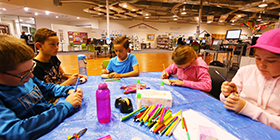
Sally and Angela report back from the last Craft Snippets event at Upper Riccarton Library. The first Craft Snippets event in 2026 will be with embroiderer Julie Clemett on 28 January.
It was our pleasure to have Gankhuyag Mungunjiguur or G, as he prefers to be called, talk to us at the most recent Craft Snippets event. G and his wife Jessie are felt makers and he shared the interesting background on how they came to be in the business.

G is from Mongolia and Jessie is Chinese. They met, married and started a family in China. Whilst visiting G’s hometown in Mongolia Jessie said she felt cold, so G gave her a pair of traditional felt shoes to wear. Jessie couldn’t believe how warm and comforting they were and when back in China she decided to try to make the shoes herself. G couldn’t understand her love for the shoes that as a child he didn’t like wearing. Jessie was determined to have a go at making a pair. Never having done felting or shoe making before and with no access to YouTube or Google in China she had to rely on friends living elsewhere to download videos and send them to her. In her first year Jessie made 1 pair. In her second year Jessie and G created a business and made 54 pairs of shoes. Come their 3rd year they had made over 300 pairs.

Their Chinese business was established in 2014. It was a steep learning curve for G and Jessie. They lived for 4-5 years in Jessie’s hometown of Harbin which is close to the border with Russia. One day in 2017 G came across a woman visitor from Russia who was carrying a beautiful, felted handbag. It was love at first sight (for the handbag). Whilst talking with the woman G learnt that she taught felting and so it was arranged for G and Jessie to spend 4 days in Russia under her expert tutelage. They learnt that you need the best materials to make felt if you want to make top quality products.

In Mongolia yak wool/fibre is used. The very soft wool of a yak comes from its neck. Rather than being shorn yaks are combed for their wool. The softest wool is used mainly for clothing and home products whilst the rest of the wool which is the toughest is used for ropes and yurts. One adult yak produces around 300g of neck fibre. G is a bit unsure about the labelling on items saying 100% yak fibre, as yaks are only farmed in Mongolia and China and there just isn’t enough soft fibre produced every year for that to be a true claim. There isn’t a lot of difference between yak and cashmere fibres. It is very hard to get close to a yak as Jessie found out one day when she was determined to ride one! Even the baby sheep were too fast, or Jessie was too slow according to G. Yaks rub themselves on hard surfaces and patches in grasslands. A lot of people collect all of this to add to what is combed. A yurt is always made from yak wool as the yurts must last a long time and there are several steps in this traditional process. Yak fibres have warming/cooling properties along with being rain repellent. There is a lot of grease in it.

At the end of January 2025 G and his family moved to New Zealand and settled in here in Christchurch. G is finishing his master’s in architectural engineering at UC and Jessie is a marine biologist but now she is focusing on family and the setting up of the business here as well as maintaining the one in China. They not only make felted shoes but have moved into the fashion arena where they make items like scarves, jackets, handbags etc. The items that G showed us were so soft, finely felted and just gorgeous really. All of us wanted to take the scarf home! And we did enjoy the sentiments in Jessie’s wall hanging about breastfeeding. Now that the family is settled into life here in Christchurch and G will finish his studies this year the plan is to develop this side of the business more.


Thank you G, for a most interesting and informative talk. We look forward to seeing your business grow.
Some useful points about felting:
- Wash the fleece in warm water with soap. G has tried many different soaps here and overseas and his favourite soap for washing and felting is good old Sunlight soap. It is also very cheap.
- Valais Blacknose sheep fleece is one of the best in NZ for the quality and staple length of the fibre.
- Card the fibre. NZ wool is easy to be felted just like Mongolian wool.
- What wool type to use depends on your project. Coarse wool is strong and tough, and flexible for shoes.
- To make a bag G works on the shrinking ratio of 1:1 and he likes to “shrink to the last possible shrinkage of the item”.
- Laying out the fibre for felting: lay by hand on a table or on a template. Use different layers of carded wool, around 25g. Use hot or cold water to felt. G prefers hot water.
- Natural dyes are better than manufactured ones.
G’s Instagram posts: Mungun Anu (@mungunanu)
Looking ahead to 2026
Our lineup of our proposed guest speakers for next year, 2026 is:
- 28 January, Julie Clemett, embroidery
- 25 March, Nikki Wallace-Bell, ceramics
- 27 May, Atefeh Osouli & Bahar Qashqai, texture art
- 30 July, Gina Russell, linen and natural dye plants farm
- 30 September, Christine Powell “Knitting in Antarctica”
Keep a look out on our website closer to the dates to read about each event.
Upcoming craft events
- Makers & Creators Christmas Market: Instagram
- The Great Stash Swap, Upper Riccarton Library, Sunday 22 February 11am to 2pm
Latest craft titles
Items shared at our November gathering
Wishing you all a wonderful Christmas and a Happy New Year. Keep on crafting in 2026.
Angela and Sally

Add a comment to: Craft snippets: Felting with Gankhuyag Mungunjiguur