

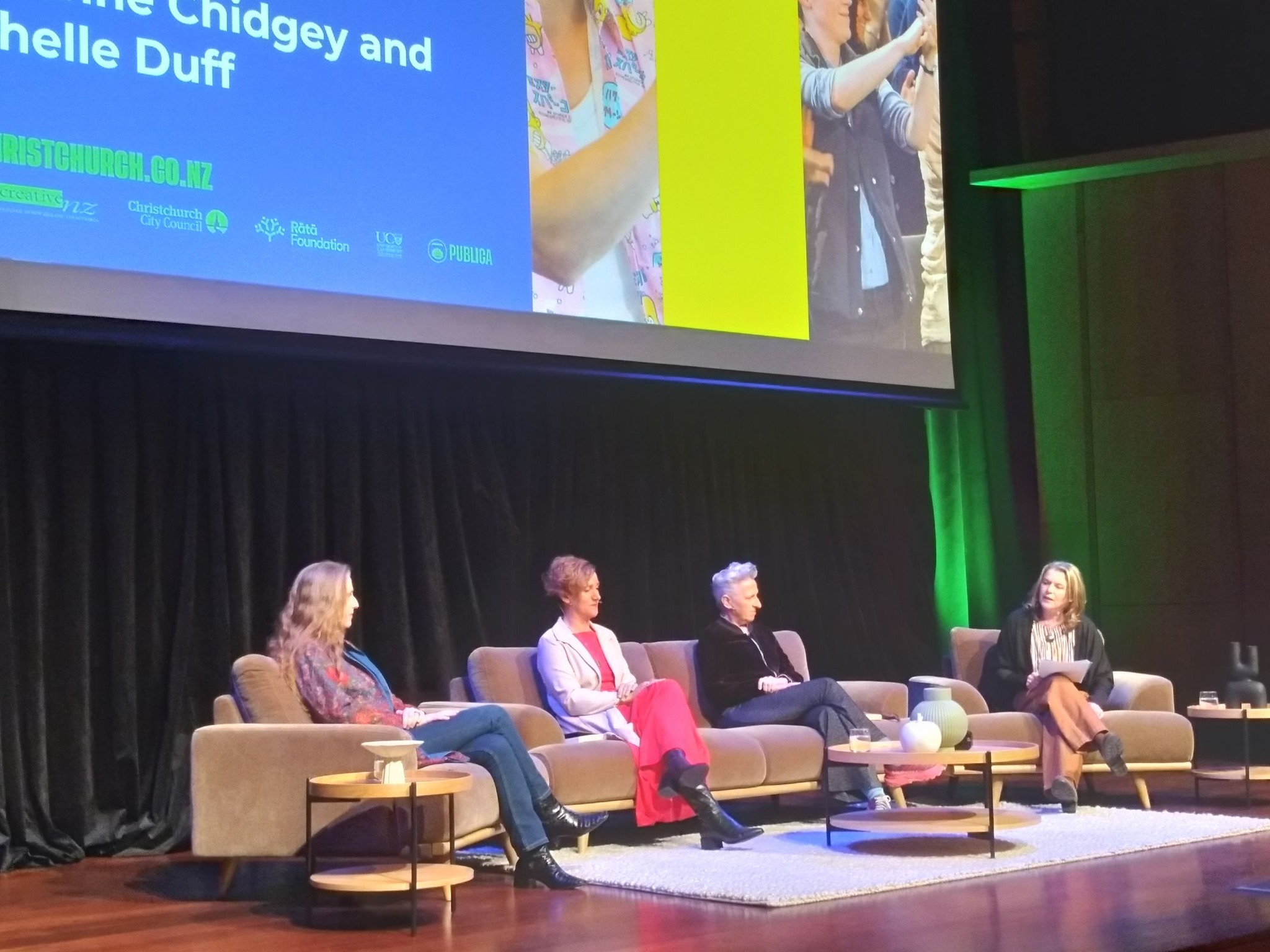
Catherine Chidgey, Michelle Duff and Charlotte Wood shared the inspirations for their latest books The Book of Guilt, Surplus Women and Stoneyard Devotional with chair Kerry Sunderland and a buzzing crowd in Queens of Atmosphere at The Piano's Philip Carter Auditorium on Saturday afternoon.
Kerry Sunderland introduced Michelle Duff, saying, 'don't read Surplus Women too fast - savour it.' Charlotte Wood's Stoneyard Devotional? 'Meditate on it.'
Catherine Chidgey? 'Critically acclaimed and beloved.' The Book of Guilt is her ninth novel and fourth in a decade (it created an international bidding war), yet she finds time to teach writing at Otago University. Apparently Tama (the magpie) helps her with signing books.
What does atmosphere mean to these authors?
Catherine Chidgey opened with disappointment at not being issued tiaras backstage. Atmosphere, to Chidgey, means feeling unsettled. She maps the world she's building against the real world and twists. In The Book of Guilt, Chidgey frames 1970s U.K. with fashion, food, tv and music - but something's off, making the reader pause: hang on, the moon landing didn't happen in the 1950s!
Surplus Women is journalist Michelle Duff's first work of fiction. In journalism, the term for setting a scene is colouring. Atmosphere for Duff is giving a scene a sense of time and space. Surplus Women is vivid with women's voices: from the 1990s where you can smell the Impulse and shampoo, 2022 where women have careers and forget the milk, and 1922 when being up the duff (no pun intended) could kill you.
To Charlotte Wood, sensory details are important to creating atmosphere. Her narrator's voice echoes into the mood and setting, the 'air' of the book.
Duff reads from the title story of Surplus Women, creating a stir - she turned down the corner of the page. It's the modern bit and it resonates with many: Zara drops her baby off at kindy and makes her escape before there's a meltdown - complete with milk on her lapel - sniff-testing her armpits on the way to work at Archives New Zealand, where she spills the contents of her bag in the rush to her desk. Her colleague is nice and doesn't comment when she's late, or called out to a sick child, unlike her previous job where she lost a client to her male colleague on her return from maternity leave, and left.
Catherine Chidgey reads, 'from the page I've bookmarked' , she says pointedly (much to our amusement). It's a very funny piece from the children's socialisation days. The boys on the Sycamore Scheme are visited by young ladies and picnic in the New Forest, supervised by one of their 'Mothers'. Diane is affronted by the lack of egg in her scotch egg: 'It's wrong to mislead people.' 'An important lesson', says Mother Afternoon, but doesn't elaborate.
The ponies of the New Forest haunt the margins of the story and add to the sense of unease. They're wild, but not wild. Owned, but free to roam. William says they might bite, Laurence says the foals will be taken from their mothers soon. Humour, says Chidgey, is also part of the atmosphere.
Charlotte Wood reads: 'I'm going to fold my cover back!' then can't read the obscured text. 'A rookie mistake.' The audience is in stitches. She reads from the beginning: her narrator visits the 'lawn cemetery' - in reality, dusty dead grass with ugly, machined headstones, so uniform that she has to remember the unsettled feeling of their funerals, to be able to find her parent's graves again. She muses on the function of faded, ugly, knobbled plastic flowers laid by others at untended graves. There is a strong sense of place in this book.
Wood's intent with Stone Yard Devotional was to master what Saul Bellow called 'stillness in the midst of chaos.'
Chidgey's intent in The Book of Guilt was to create an 'interiority' with the points of view of Vincent, Nancy and the Minister of Loneliness. The boys live in a small sphere; attached to physical things important to them, all the knowledge in the world contained in their library. Nancy is never allowed out of her home. The character of the Minister, knowing differently, creates a voyeurism between the reader and the text.
In Surplus Women, at first there was no connecting thread between the characters' stories. But they were all looking at the same question from different perspectives. Some characters are revisited from different angles, popping up in other's stories. The question?
'What does it mean to grow up a girl in Aotearoa?' 'I tried to write other stories that weren't about the patriarchy but I couldn't.'
Kerry Sunderland asks about place. 'I start with place,' says Charlotte: 'its effect on people, and put people in it.' She used to think the Monaro Plains, her setting, were bare and ugly; later realising they were made of beautiful colours. It's a stripped back emotional terrain for a character who leaves the city, her job and her marriage, to join an order of nuns. She's spiritually and psychically denuded, having hit a wall, feeling that the landscape understands her emotional state.
Wood created 'micro moments' to relieve the silence and stillness: a plague of mice, a vocal celebrity 'rogue' nun - summoning an image of rogue nuns who go around the world causing trouble in the name of justice. LOL.
This is a segue into The Book of Guilt, with the Mothers, Morning, Afternoon and Night, nun-like characters.
Chidgey notices things and tucks them away to use later. This book came from a visit to the New Forest (U.K.), with the powerful, mysterious, wandering ponies. The pseudo science on her book Remote Sympathy influenced this story: the moral implications and usefulness of experimenting.
Wood also notes something in the world, tucking it away to use later. Writing about her hometown in the Monaro Plains had to wait for the right book. As a younger writer, she felt she had to disguise everything but doesn't care any more.
Duff too, sees the 'aura' of something and waits for its purpose to emerge, to follow where it may take her. 'Surplus Women is absolutely not me,' she jokes, but people say it resonates, feels true, musing on how love of a fiction book comes from its truth.
Does the finished story bear any resemblance to the original?
Duff rewrote lots, finding her characters resurfaced. Chidgey tends to edit to a finished product while writing each scene. Wood's first drafts can take two years - ideas come slowly, but editing is quicker, resulting in a sparer, less cluttered piece of work.
If place and setting are the anchor, is theme the engine?
Wood: 'I don't try to steer it too much', letting themes come without controlling the reader's journey as if forcefully saying 'I've got something to tell you.' The 'rogue activist celebrity nun' and the old schoolmate neighbour are a way to create distance between them and the stillness of the narrator.
Duff: themes emerge from the characters, like the one who pees in a pot plant (it's a Monstera), or the detective who forgets the milk, but notes a bruise on her daughter. Duff moves from third person to first, un-naming some of her characters, who are more like avatars.
Chidgey uses the Minister of Loneliness, the only one with knowledge of the outside world, to obfuscate and talk around the big issues, while her perception of the boys in the Sycamore Scheme change over time. She puts unlikely characters together to see what connections form.
A member of the audience describes The Book of Guilt as like 'reading honey'.
Is it an out of body experience when you write? Charlotte Wood feels it's best when the writing feels like its coming from somewhere else, if you let go of control - perhaps art doesn't come from the logical mind? Michelle Duff feels that with so many different characters, they flow because you found their voice. And Catherine Chidgey? She advises to write early in the morning, before the conscious mind wakes up.
Just like in the Book of Dreams.
More from the authors
Find books by:
More WORD
Check the programme online or pick up a printed copy from your library.
- Looking for a good read? Ask the experts stationed outside the TSB Space at the Tūranga Table. The Tūranga Table - WORD Christchurch
- Keen to read short stories with others? Check out the Shared Reading group sessions at Tūranga Library on Sunday 31 August. Shared Reading Sessions - WORD Christchurch
- WORD Christchurch website
- Follow WORD Christchurch on Instagram, Facebook and TikTok
- Our WORD Christchurch 2025 page - Find books by writers coming to this year's festival

Add a comment to: Setting, Silence and LOLs: Queens of Atmosphere at WORD Christchurch Festival 2025