
People who are willing to be resilient are resilient!
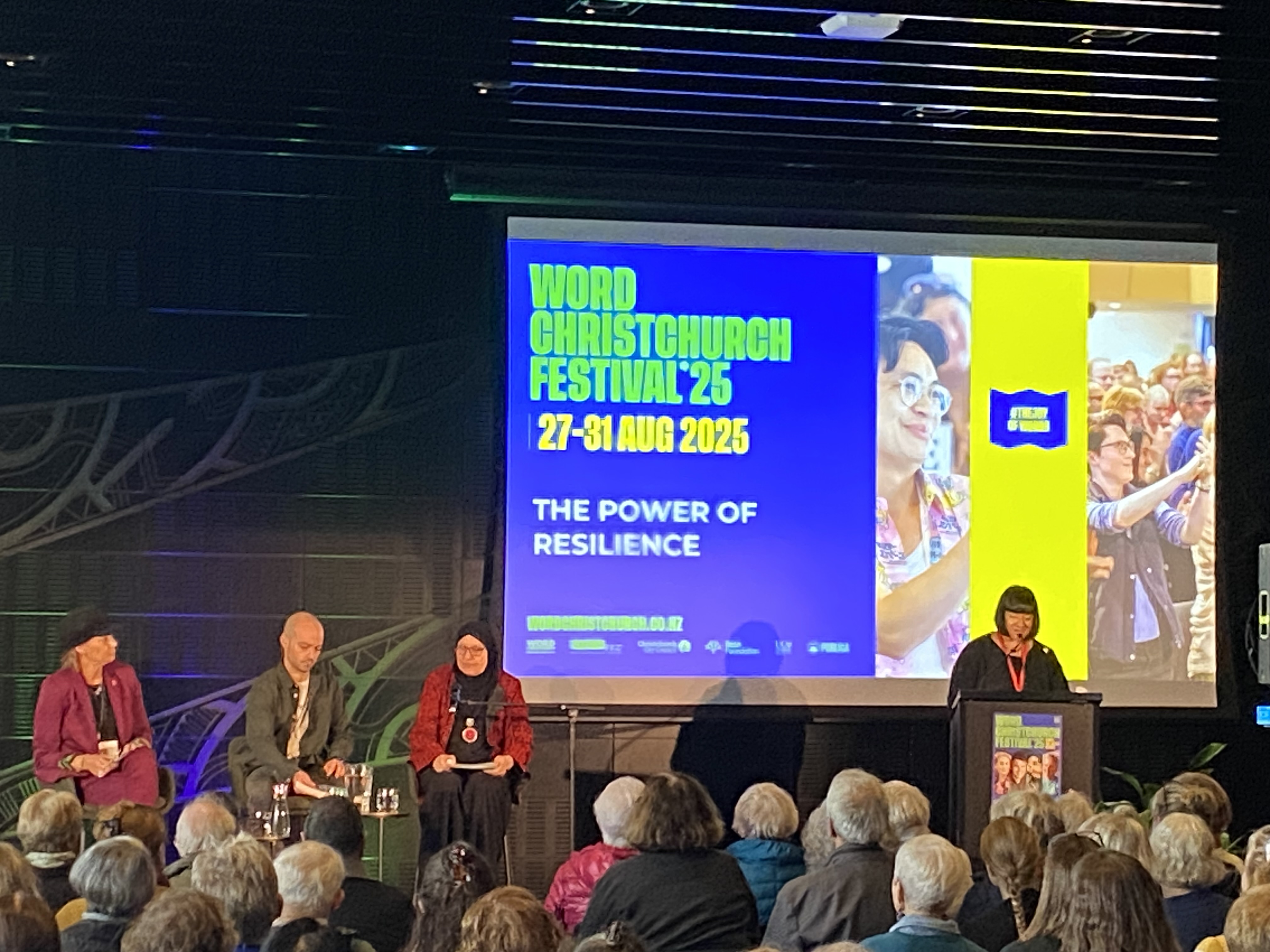
This is what I felt when I saw the crowd waiting to get into the auditorium for the WORD Christchurch Festival sold-out session The Power of Resilience on the Sunday morning. Despite the unpleasant weather, around 150 people from diverse backgrounds and of different ages were there.
Dr Lucy Hone, Jake Bailey and Dr Maysoon Salama are well-known locally and internationally for their experiences and books. The audience were ready to follow them and engaged with the topic of resilience after they briefly talked about how their life events, such as losing loved ones or being diagnosed with aggressive cancer, led them to write their books.
The conversations between them began with unpacking the concept of resilience. Is resilience about being strong? Where do they get the strength to keep going?
For Maysoon, being resilience is not being strong all the time. She said,
"We can be broken. To me, resilience is faith. It is hope. It is making best out of something that is tragedy. You can allow yourself to grieve. You can fall apart. But at the same time, you find the purpose for your life to keep you going... at a certain time, you can put one foot in front of another. This is resilience."
She thought that the strength came from her family and community who brought love to her.
Jake recalled the moments when he was very sick and realised that the strength was also coming from people around him. His interpretation of resilience is shaped by his experience of working with and talking to young people and students over the past five years. For him, resilience is about the ability to be flexible and adaptable - responding to changes and continuing to move forward.
Thinking about her toughest moments, Lucy commented that resilience is not about simply bouncing back. Instead, all happenings shape and change us - who we are and what we believe. We have to adapt and navigate our way through the process. She emphasised:
"It is important to know our own "recipe" so we can shape the environment we want and move towards the strategies that suit us."
One point three writers share is that people do not live in isolation, which led to a discussion about the role of community in their experiences. They all expressed gratitude for the support they received from their communities. Maysoon thought that families and communities are essential for her to keep going. She recalled how people from overseas Muslim communities came to Christchurch to support them. Strangers, both locally and around the world, sent flowers and cards with loving and caring messages. With their support, she felt a responsibility to talk and write about hatred and love. This gave her a sense of direction for the future and a purpose that motivated her to move forward.
Jake reflected how important the support from the board community was to him. He vividly described it:
The principal came to visit me and brought in boxes of paper sheets which are emails the school had received and printed out - messages of love, caring and support from all over the world. The impact was very tangible. I kept the boxes by my bed in the hospital room. At my low point, I would roll over and pick up one letter to read those words of compassion from a complete stranger. I was incredibly fortunate that I could do that... Now, I am fully aware how important this was for me...
His description reminded me of the first sentence in the introduction of his book What Cancer Taught Me. He was grateful to the New Zealand taxpayers for the money spending on his treatment so he could survive. He acknowledged the hospital staff, the school community, people in Christchurch and New Zealand for their support.
Lucy talked about how to support people to go through grief and emphasised the importance of long-term support. She shared that those going through such experiences often feel judged, isolated, and alone and truly need the support of others. At the same time, she reminded us to avoid being judgmental, as no two losses are the same, and people grieve in different ways.
Three speakers agreed that resilience is an ability people can learn, practice and develop. Jake believed that he developed resilient skills over time, better equipped himself to handle difficulties, and learned to appreciate life - all factors that contribute to a better life. Maysoon thought that new responsibilities and purposes helped her make positive changes and required her to become resilient. Lucy agreed with them, and added that tough times required us to be courageous and brave - even a small amount of bravery and small steps can help.
When people are purpose-driven, tough experience can help them learn and grow. To conclude, the three speakers summarised what they had shared with the audience and used their experiences to illustrate the five dimensions of Posttraumatic Growth (PTG).
Lucy explained how the strength they gained illustrated the first dimension of being more stronger than ever before.
Jake spoke about the second dimension of gratefulness and appreciated of life through his experience of surviving from cancer.
Maysoon thought that the tough situation strengthened her connection to her belief and faith, illustrating the third dimension of spiritual change.
The fourth dimension, relation to others, was clearly evident in their stories.
Finally, they used excerpts from their books listed below as examples of the fifth dimension: new purposes and opportunities and wished people could look after themselves and others well with the power of resilience.
Find out more
- Find titles by Dr Lucy Hone, Jake Bailey and Dr Maysoon Salama in the catalogue
- Find titles on resilience in the catalogue
- Browse our WORD Christchurch 2025 page
- Visit the WORD Christchurch website
- Follow WORD Christchurch on Instagram, Facebook and TikTok

Add a comment to: The Power of Resilience: WORD Christchurch Festival 2025