
Lunar New Year's Day falls on 17 February 2026. As a major festival celebrated in some Asian countries, including China, Vietnam, and Korea, it has long-standing history and rich cultural traditions. Today, people from diverse backgrounds celebrate Lunar New Year to exchange good wishes, enjoy festive food and activities, and reunite with their families.
This year, we offer various events and activities in libraries from 14 to 28 February to celebrate this traditional festival.
The Year of the Horse (马年)
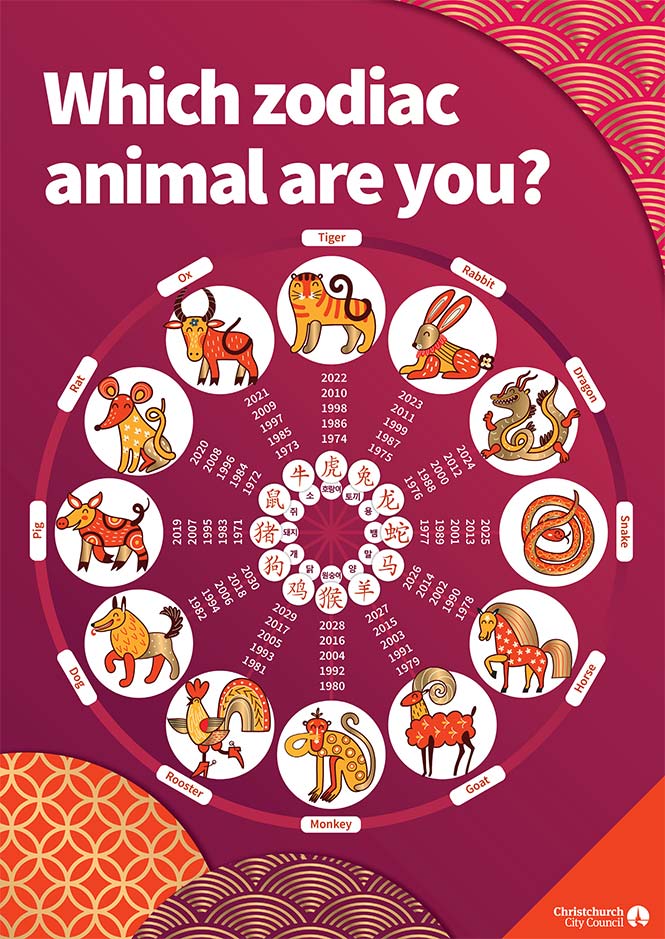
Based on the 12-year-cycled lunar calendar, this year is the year of the horse, starting from 17 February 2026 to 5 February 2027. The year of the horse includes 2026, 2014, 2002, 1990, 1978, 1966, 1954, 1942, 1930, 1918... Come to libraries for Chinese-English bilingual storytimes sessions to learn about all zodiac animals and the year of the horse.
People born in one of these years will be in their year of fate 本命年. According to Chinese tradition, people in their year of fate should wear red on Lunar New Year's Day and even throughout the year to ward off evil spirits and maintain good luck. If you want to make something red for yourself or your loved ones to wear or decorate, come to craft activities of Lunar New Year Celebration of Culture at Tūranga on 14 February.
The horse holds an important position in Chinese culture. Various horse-like creatures, or horses with unique features, are a major motif in Chinese mythology. Among them, the Dragon Horse (longma)龙马 and the White Dragon Horse (bailongma)白龙马 are particularly well-known.
The Dragon Horse is a mythical creature characterised as a winged horse covered with dragon scales. Although such a hybrid creature appears in various cultures, the Dragon Horse carries a specific meaning in Chinese tradition. It is believed to symbolise good fortune, wisdom, and vigorous spirit. The idiom "dragon horse spirit" (long ma jing shen) 龙马精神 describes people who are full of energy, strength, and resilience.
The Dragon Horse is also regarded as an auspicious omen signalling the advent of legendary sage-rulers known as "Three Sovereigns and Five Emperors" (san huang wu di) 三皇五帝. In mythology, the Dragon Horse serves as an intermediary between heaven and earth and as a messenger between the sacred and the secular. It brings a "Yellow River Diagram" (Hetu) 河图 to Fuxi, the creator of Chinese humanity and civilization. The Yellow River Diagram embodies ancient Chinese cosmology. Together with "Luo River Writing" (Luo Shu) 洛书, which contains ancient magic square arrangements associated with "Five Phases and Eight Trigrams" (Wuxing Bagua)五行八卦 and is carried by a turtle, the Dragon Horse ensures that the sage rulers govern based on divine principles.
The legend of the White Dragon Horse is closely associated with Buddhism. The White Dragon Horse is one of the main characters in Journey to the West (Xiyouji) 西游记, one of the Four Great Classical Novels of China. The third son of the Dragon King of the West Sea is punished for his misconducts and transformed into the White Dragon Horse. He then serves the monk of Tang Sanzang, carrying the ancient Buddhist scriptures from India to China during a nineteen-year journey. The White Dragon Horse symbolises perseverance, whereas the main characters in the novel represent different aspects of the human mind and personalities. The White Horse Temple, opens a new window in Luoyang, the capital of Henan Province, honours the divine creature.
The Horse in Chinese Practices
Historically, the horse has a significant presence in China, influencing its military, economy and arts. Hundreds of life-sized horse sculptures from the Terracotta Army were discovered in the tomb of the First Emperor of China (Qin Shi Huang)秦始皇. Alongside the warriors, they guard the Emperor in his afterlife. The discovery highlights the military significance of horses in ancient China. It is also believed that the Great Wall was constructed as a defence against the warfare associated with horses, as the southern provinces of ancient China were constantly threatened by invasions from by northern nomadic warriors on horseback.
The well-known Horse Caravan of Yunnan Province (Yunnan mabang)云南马帮 played a crucial role in tea-horse trade and cultural exchanges between Southwest China and Southeast Asian countries in ancient times, dating back to the Tang Dynasty (618-907CE). The trade route is known as the Ancient Tea Horse Road (cha ma gu dao)茶马古道, or referred to as the Southern Silk Road.
Horses are one of the most compelling subjects in Chinese painting arts. Night-Shining White (ye zhao bai)夜照白 is one of the most renowned masterpieces. The monochrome ink-on-paper painting, by Tang Dynasty artist Han Gan 韩干, depicts a steed owned by the Emperor Tang Xuanzhong (reigning 712-756CE). The portrait captures both outward appearance and inner essence of the horse.
Another famous court horse painting is One Hundred Horses (bai jun tu)百骏图 by Giuseppe Castiglione, an Italian painter who served the emperors of Qing Dynasty (1644-1911) under the Chinese name Lang Shining 郎世宁. This monumental scroll masterfully combines traditional Chinese aesthetics and Western painting techniques.
Xu Beihong is one of the most influential Chinese artist known for horse painting. Regarded as the father of modern Chinese painting, he develops a new painting style that blends Chinese brush-ink techniques and Western approaches to colour and perspective. With the Chinese-Western fusion, his depictions of horses, such as Heavenly Horse and Galloping Horse, captures the power and dynamic feature of the animal, while expressing his patriotic feelings.
Four-character Chinese idioms (chengyu) 成语, originated from various aspects of Chinese society including ancient literature, historical events and myths, convey philosophical teaching and wisdom. The horse-related idioms are widely used in the Chinese language. The following are some examples.
- 老马识途 (lao ma shi tu): Old horses know their way.
It means that someone is capable and can handle a situation. - 马首是瞻 (ma shou shi zhan): Follow the horse's head.
It shows that people are willing to follow someone's lead. - 马革裹尸(ma ge guo shi): Wrap the corpse in horsehide.
It suggests that a real hero should die in the battle and is buried in horsehide. - 塞翁失马 (sai weng shi ma): An old frontiersman loses his horse.
It expresses that when losing an opportunity, you don't have to be upset. It can be a blessing in disguise. - 走马观花 (zhou ma guan hua): Glimpse flowers from horseback.
It describes that people view something hastily and do not fully grasp it. - 马到成功 (ma dao cheng gong): Success upon the horse's arrival.
It conveys wishes for good fortune and instant success. - 指鹿为马 (zhi lu wei ma): Point at a deer and call it a horse.
It means that people deliberately distort the truth and manipulate others for their self-gain. - 万马奔腾 (wan ma ben teng): Millions stallions gallop.
It describes a formidable and unstoppable force. - 悬崖勒马(xuan ya le ma): Rein the horse at the edge of the cliff.
It describes the situation that people are in the brink of danger but realise and come back in time.
Calling for Thousand-li Horses and Bole
Based on Chinese myths, historical events and practices, the zodiac sign of the Horse is generally associated with traits such as courage, integrity, diligence, power, resilience and wisdom.
Beyond these qualities, the horse embodies a distinctive idea discussed in an ancient Chinese essay entitled "On Horses" 马说 by Han Yu韩愈, an influential poet and prose writer of the Tang dynasty (618-907CE). It reads
Only after Bole comes into the world are there thousand-li horses (qianlima). Such horses are common, but a Bole is rare.
世有伯乐,而后有千里马。千里马常有,而伯乐不常有。
These lines mean that many qianlima may exist in the world, but they can only be recognised when a Bole appears. In other words, the world is not lacking in qianlima but true Bole are rare. Both Bole and Qianlima are legendary figures, referring respectively to a master judge of horses and a horse capable of running 1,000 li (500 kilometres) in a single day. Han Yu employs them as metaphors to illustrate the relationship between talent and those who can recognise it, highlighting the crucial role of the latter. Accordingly, the idiom of "Bole recognises the thousand-li horse" (bo le xiang ma) 伯乐相马 is used to emphasise the importance of mentors or leaders who have the wisdom to identify and properly nurture talent.
Although the essay was written over a thousand years ago, the message it conveys is highly relevant today. Both qianlima and Bole are essential in the contemporary world. In the Year of the Horse, let us revitalise the spirit of fine horses - striving to become qianlima ourselves, while also willingly serving as a Bole to offer recognition, guidance and support to others.

More Lunar New Year events and information
- Library events and activities during the Lunar New Year 2026 Celebrations
- Happy Chinese New Year Festival 2026 in Christchurch
- 2026 Christchurch Lunar New Year Parade
- Library resources on the Lunar New Year
- Library resources on the Chinese New Year
- Library resources on the Chinese zodiac
- Picture books on horses
- Children's nonfiction books on horses
- Children's fiction books on horses
- Adult nonfiction related to horses
- Adult fiction related to horses

Add a comment to: The Year of the Horse