

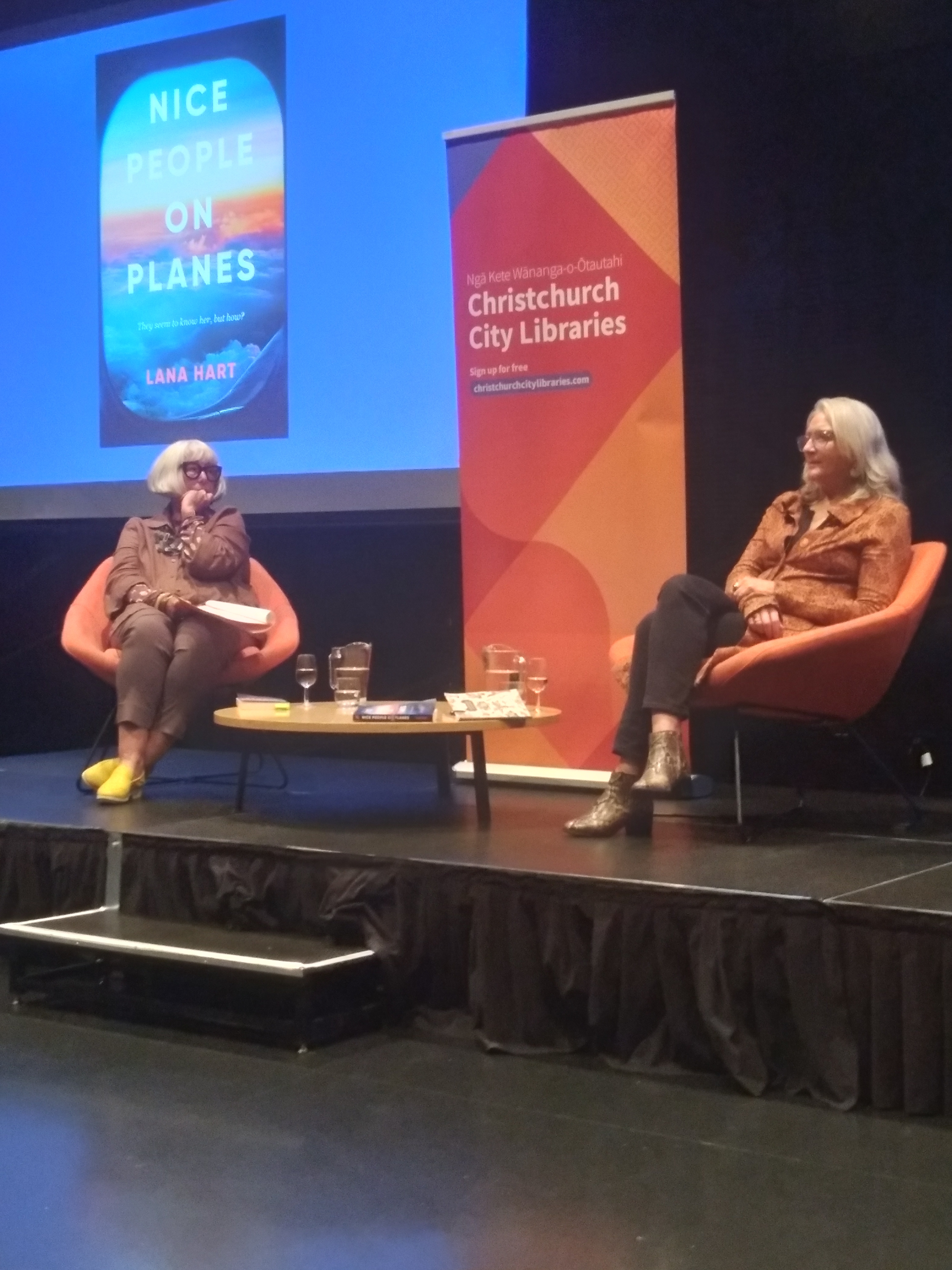
On Wednesday 4 February this reviewer was treated to an evening of delight, camaraderie and community with Lana Hart and Morrin Rout. And wine and cheese. A winning combination!
Nice People on Planes is Lana Hart's first foray into fiction. She's no stranger to writing, however, having been a journalist, scriptwriter and award-winning podcaster for Plains Media Te Reo Irirangi o te Maania. Lana was also the lead producer / project manager for the podcast Widows of Shuhada, in which four Muslim women widowed by the Christchurch mosque attacks share their journeys through a year of grief, the impact on their communities, and the steps they're taking towards a different life.
An American-born Kiwi, Lana's focus has been on travel and people and this transfers to her fiction writing, having spent a LOT of time travelling as part of her role as a human rights and diversity specialist helping new settlers make a home in Aotearoa and navigate all the hoops immigration requires of new New Zealanders, often with a language barrier.
Here's how Lana responded to Morrin's questions:
What skills from your career were brought into this book?
Lana has had much experience travelling. In 2017 she supported Filipino immigrants to settle in Ōtautahi Christchurch, travelling every six weeks between the two countries. Not only that, Lana has travelled regularly between her hometown in Chicago and New Zealand. This transfers to the character of Cora in Nice People on Planes, who experiences a disconnect from family, her interests, and even her own body; a common state for anyone who travels. Lana describes a sense of belonging yet not belonging to two places at the same time, being in a kind of limbo in clinical, prescribed square hotel rooms and looking at clouds, suspended above the Earth for long periods at a time.
Your themes are grounded in your travels and life's work, where you pick up and tell stories of how people adjust to new places and experiences. What did you put aside to do this?
Lana found it fun to put aside non-fiction writing, where she told other people's stories, to fiction, where she could tell her own, beginning with short stories. She found editing a challenge and very different from journalism: a medium which re-imagines truth. In fiction you can take the 'ideas in your head' with a power over the life, death, language and motivations of your characters.
Writing, at its best, is a lonely life. Ernest Hemingway
A journalist can't operate in isolation - having to rely on others' stories and opinions whereas a fiction writer is alone with their thoughts, writing in a quiet space. Lana is hopeful of finding a balance between these worlds.
The character of Cora, who narrates Nice People on Planes, has experiences similar to Lana's real-life ones. Which bits?
Cora is a modern twenty-first century woman. She's leaned on by people, she's a worrier, a catastrophizer, who lives with the anxiety of not coping in a busy world. She's a solo mum with three marriages under her belt, yearning to fill an empty space in her life. Cora has a lot of layers like many of us (women), says Lana. Her move to New Zealand lays a bit of this to rest, as it did for the author herself - who moved here in the 1990s, settling in Tāmaki Makaurau. There's less of Lana in this story than in her travel memoir - Lana, unlike Cora, doesn't like to relax to heavy metal music. Lol.
The timeline of Nice People on Planes moves from reminiscing with fellow passengers in the air to scenes in Coromandel on a family property. Was that fun to do?
At first the story was chronological, with all the plane stuff at the beginning. This pacing gave her beta-readers jet lag, says the author. It was painstaking, taking almost a year to realign, with all the facts out of synch. This was essential, says Lana, and actually fun when she began to see how things worked, and belonged, forcing readers to work to find the connections. Chekhov's gun, says Morrin: details are there for a reason.
Cora has a strong connection with New Zealand, but was the book written for a wider audience?
Lana uses the character's cultural knowledge of the U.S. and New Zealand to reach international readers. Lana's life is here but she also has relatives back in the States. She says Kiwis aren't as open to talking to strangers as candid Americans. This was fun to explore. Apparently Americans love Aotearoa as a setting.
Lana did two readings for the audience. In one, Cora uses clever questioning to puzzle out a passenger's ethnicity and culture, rather than asking the intrusive question, where are you from? The other reading illustrates Lana's skill at describing scene - conveying Cora's connection to the Coromandel bush and landscape with vivd imagery: birdsong, ocean sounds muffled by the depth of the bush, Kauri 'like an ancient cloak' mist, and the powerful, unnerving feelings generated by a waterfall. Beautiful scenes such as this are contrasted with the clinical environment of airports.
Cora's strength is drawn from the natural world of bush and clouds, while gazing for hours from plane windows. Do clouds play an active role in the story?
Lana says this is a potential spoiler. She's interested in the science of clouds and talks about them with her partner, an avalanche rescuer. However, the focus in Nice People is on how clouds relate to Cora's emotions and how she and her grandmother, in particular are connected to the natural world. Clouds are different here (Aotearoa), than the U.S. with its wide landscapes. They're different in Ōtautahi too, compared to the Waikato, says Morrin Rout.
Lastly, what about the process and learnings of self-publishing, distribution and promotion?
A long journey, says Lana, giving a book 'oxygen', involving many submissions to publishers (only 1% of these are successful). It's difficult to get published, you can get 'stuck in the machine', when you want to move on to the next story. With this is mind, Lana self-published in the end, and learned how to 'kill your babies' - reducing a manuscript of 120,000 words to 65,000.
Any advice to aspiring writers?
Write write write!

Add a comment to: Nice People on Planes – Lana Hart