
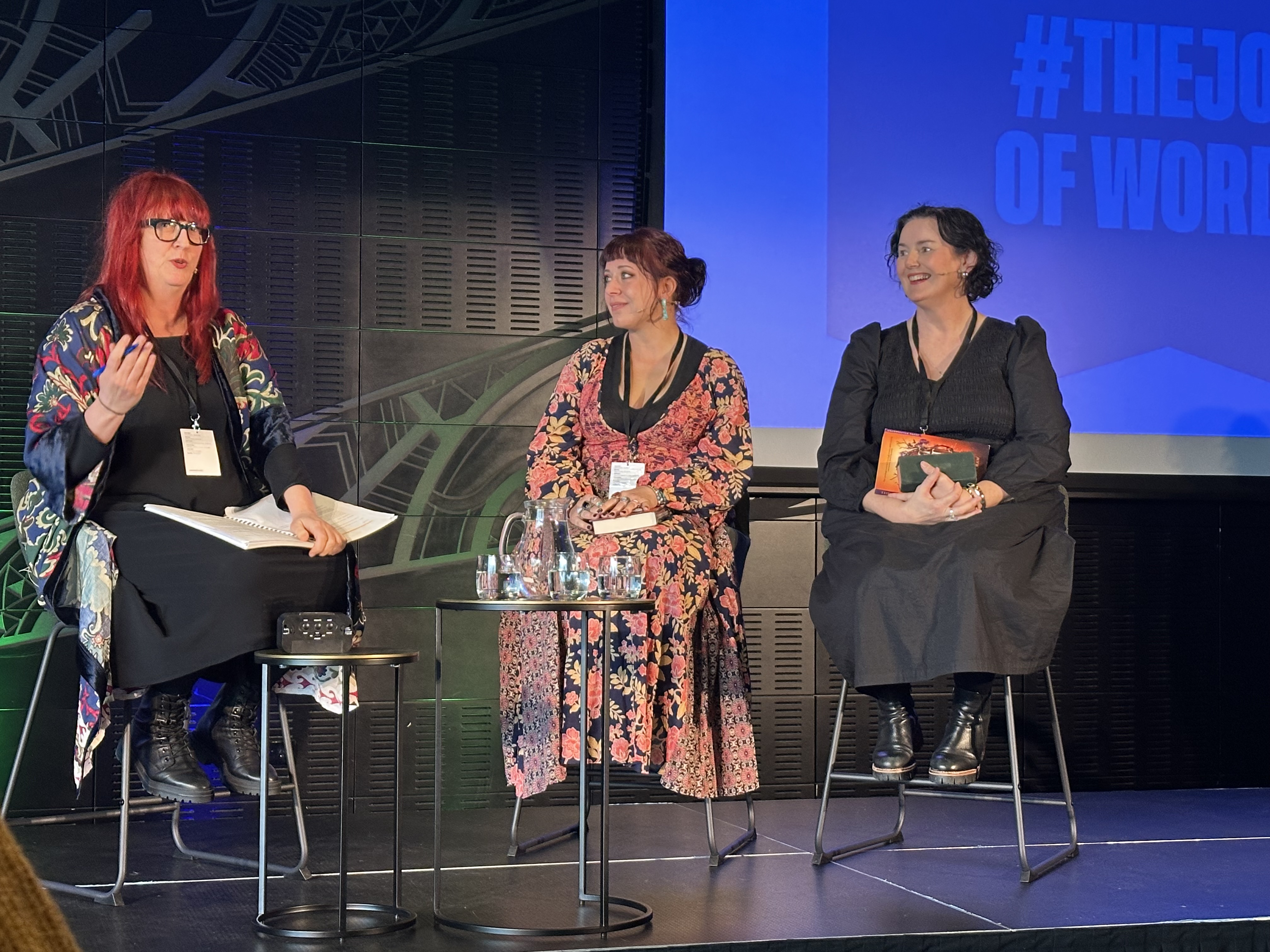
It was an excited crowd of mostly - but not only - women in Tautoru / TSB Space, Tūranga on a drizzly Sunday afternoon. This warm little panel, chaired by the indelible author Rachael King (who also had a book launch as part of the WORD Christchurch Festival), celebrated all things whimsy and brilliant about two truly wonderful romantic fantasy novels: A Harvest of Hearts by Andrea Eames, and The Lost Saint by Rachael Craw.
I was fortunate enough to get lost in their fantastical worlds over the past month, and was thrilled to hear Craw and Eames tell all in person about their craft, their characters, and the culture of reading.
The books
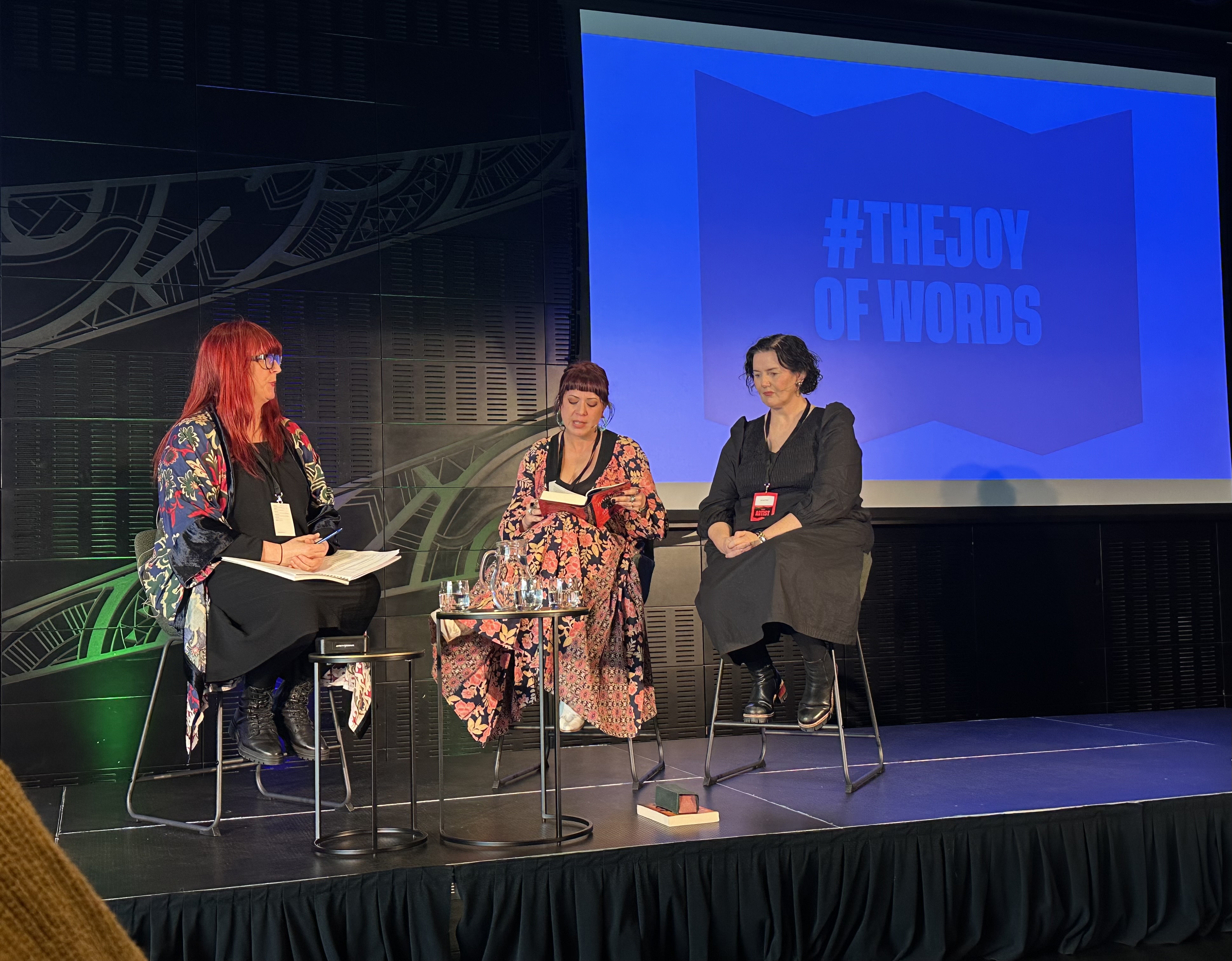
The session began with each author introducing their book in their own words, and reading a brief passage (which for both, happened to be the meet-not-so-quite-cutes between their leading ladies and their love interests!)
Rachael Craw's The Lost Saint is a time-slip novel - but it wasn't always intended to be so. Craw, who knew her book should be set in a medieval castle but wanted a modern girl protagonist, came to the idea of a jump through the ages as a way to marry the two concepts. The story follows 21st century teenager Ana, a charming and strong-minded student at an international school. Her class, visiting the landmarks of a medieval saint, sneak out one evening to a cave for a party and are propelled into the past by a - quite frankly - horrendously terrifying earthquake. Many of her classmates are killed in the cave, and some of the escapees soon meet a sad end. Because guess what? At the end of the tunnel is not a summer night in modern Germany, but instead a bitter, brutal winter battle between medieval nights in the frosty 1300s. Craw apologised - "Sorry, it's quite grim!"
Ana gets separated from her surviving friends, and so embarks on a journey to the castle of a saint, who may or may not have strange, holy powers that can send her back to the current day. Oh, and her travelling companion is a handsome knight in shining (and bloody) armour.
The passage that Craw read, Ana and Leon's introduction, shows both characters in a rather bad state. But it still has moments of dark hilarity:
Her skin was grazed and she was reaching with all her might for a small rectangular object. A box? Impossibly thin and dully gleaming, it was lodged at the root of a bramble bush. ... 'You need a stick,' he croaked. She yelped, losing her footing, and skidded back to the grass with a strangled cry. She grabbed his sword and whirled towards him, struggling to bear the weight of her blade. 'I seem to have one,' he gestured, flapping at the branch protruding from his side. 'It might serve the task.' Her eyes darted to the wound. 'I should drive it all the way in and this sword too.'
Andrea Eames's novel is a dark fairytale that has been compared to the great Howl's Moving Castle by Diana Wynne Jones. It follows a "short, plump, ordinary and plain" heroine, Foss, who is a butcher's daughter. This characterisation of her main protagonist was important to Eames - she wanted to present someone who did not change how she looked throughout the story, did not realise that she was "beautiful", and whose appearance was not particularly important to the plot.
The glorious tale is set in a land where magic is performed, presumably for the good of the kingdom, by beautiful sorceresses who harvest their powers from people's hearts. The villagers all accept that this is simply how life is. But everything changes for Foss when her heart is suddenly and accidentally snagged by a male sorcerer. Their meeting is exquisitely written yet somewhat brutal:
"...The sorcerer looked at me. Really looked, so that there needed to be a new word for looking that didn't just mean eyes pointed in a direction. I could say that it seemed like no one else existed in that moment bar me and him, and I could say that sounds faded, and I felt his stare like something real and sharp going right through me. These things would all be true, but not in the way you hear lovers say them. The best I can compare it to is when I got a great thorn through my foot, one of the devil thorns that grow by the well, and it poked right between two of the bones and popped out the other side with its white head all pink with my blood..."
And so Foss must go on a journey to find the sorcerer who stole her heart. She becomes the housekeeper for his sentient house, and meets the undoubtedly most adorable character of the book - Cornelius, a talking cat. Eames stated that "it is an adult novel, but more adult novels should have talking animals." I wholeheartedly agree.
First sparks
King asked both authors what their "first sparks" for their novels were - those little ideas that grew and grew to create such fantastical narratives.
For Eames, who was experiencing a kind of "literary homelessness" after not writing for a while and becoming unsure of where to set her books, arrived at the idea of a fairytale. The first line popped in her head, and to this day has not changed:
"They said that magic, real magic, not the shite that the hedge-witches peddled with all their little bags of powders and herbs, could only be performed in exchange for a human heart."
What an opener! From there, Foss's voice came into her head, and such a strong voice it was, it told the story for her. Craw similarly commented that Ana was "her own creature" from the beginning, and propelled the narrative.
The Lost Saint was inspired by a dream of Craw's, in which she was in the tower of a medieval castle with its architect. There was a grove of trees in the middle of the castle, and Craw's dream self wondered - why would someone put a forest there? And so, the setting was born... but she still longed for a modern girl protagonist.
King commented that one of the real charms of the book ended up being this wonderful juxtaposition between the modern and the medieval. Craw said that she could have created a fantastical landscape and simply had her modern girl in a castle that way, but she wanted to ground her work in semi-historical reality. This led to a great amount of research to develop the 14th century Germany setting, and particularly how her characters from different time periods might interact with each other. Obviously, people in 1300s Germany would not be speaking English, and so Craw came up with a "creative miraculous loophole" to explain this. What is this loophole, you might ask? You'll have to read to find out.
In contrast to Craw, who has a medieval soldier describing a phone as a "musical box" and a "hurdy-gurdy", Eames didn't have to do much research. A Harvest of Hearts is a fairytale, after all! She felt that the tropes and beats of such a story were something known since childhood. To write it was a relief from her heavily researched previous books, and what's more -
"No one can argue with it. It's my world!"
The question of "romantasy"
Before heading to this event, I examined the genre of "romantasy", the trending buzzword for the amalgamation of romance and fantasy genres. The term has been used to describe both Eames and Craw's books, but would the authors consider their books "romantasy" themselves, King questioned? What are their thoughts on the genre?
Eames felt that "romantasy" was perhaps too simplistic of a term for A Harvest of Hearts, and she does not think of her book as part of the genre. This is because the story does not need the romance to survive - if it were able to be surgically removed, the fantasy story would still stand on its own. Perhaps this is why I, someone who holds a generally dubious attitude towards romantasy, loved A Harvest of Hearts so much. The book stands entirely on its own merits as a fantasy, and I love fantasy.
Craw, in contrast, said she always struggles to name the genre of her books and just goes with what the publishers say. Sometimes it can be accurate, and sometimes it can be a bit of false advertising. In Eames's case, A Harvest of Hearts was labelled a "cosy fantasy". And it certainly is, in some parts - except where it gets into the body horror!
But there is power in genre buzzwords like "romantasy" when it comes to the marketing side, as King noted. She pointed out the tropes in Eames and Craw's books, including the popular "enemies to lovers", and the slight subversion of the "only one bed" trope (only one horse)...
Craw said that tropes were interesting and fun ways to say something about a book, but she never started off writing a book by thinking about the tropes she wanted to explore. Those came naturally as part of storytelling. And if you tell a good story, the themes will take care of themselves. Eames agreed with these sentiments and added that while she does not write her books like a "subway sandwich" of tropes, she has a lot of fun in subverting them.
Where tropes really shine is for the reader. They're an awesome way to market a book to people who know what kinds of stories they like to hear. In this way, as Craw so perfectly put it, they're like an "invitation" for a book's audience.
Prose and difficult scenes
King had nothing but praise for the lovely prose of both writers. Craw, she said, has a brilliant way of putting the readers in not only the heads but also the bodies of her characters. And Eames's words were astoundingly "lyrical and beautiful." What did the authors' processes of writing look like?
For Eames, her sentence work came later. She likened her methods to "watching a movie in [her] head" and scribing what comes out as if on autopilot. The mindfulness and the refining were elements that came later. Craw mentioned her similar "visual" reading experience, a kind of cinematic closeup. She lamented that sometimes she was so close, so readily "gouging up the dirt," she could not see the bigger picture on the surface. But Eames praised Craw's ability to see her worlds through this lens - "it's what makes them so good!"
On the topic of tricky writing, King asked whether there were any scenes the authors found particularly hard to write. Craw's was a scene that is no longer there. Her first publisher - who she did not end up proceeding with - insisted that the book needed a prologue surrounding blood sacrifice and an ancient demonic entity that is later encountered in the story. Craw, who self-admittedly hates prologues, begrudgingly wrote one and was thrilled when her next publisher let her get rid of it!
Eames's tricky writing was not limited to one particular scene, but she was concerned with the issue of consent throughout the book. Foss's heart has been snagged by the sorcerer, and while this magic is in play, her feelings towards him are overwhelming and uncontrollable - she cannot rid herself of them even if she tried. Eames's challenge, then, was to figure out a way for the characters to bond outside the influence of the spell. The solution for this was to create a space in which they could interact where there was no magic. But even where there is magic, Craw noted, the consent problem never once feels dodgy. Foss may suffer from self-esteem issues, but she is remarkably headstrong and assured in other ways that are completely removed from her love interest.
A few more short questions
The session was quickly coming to a close, so the authors answered a few more questions from King and the audience, including the following:
- Favourite side characters? Both animals: Eames loves fan-favourite Cornelius, the talking cat; and Craw loves Precious, the non-talking, yet giant and soft-hearted horse.
- What were their publishing journeys like? Eames sought agents for books she had admired, and with an excellent agent under her belt was able to auction A Harvest of Hearts amongst a few publishing companies. Craw had been having some bad luck, a previous manuscript about a virus receiving over 100 rejections when Covid-19 hit. She wrote The Lost Saint to cheer herself up.
- Do you know the ending of the book before you write it? Both authors agreed that they had general ideas of where the narrative would land, but generally it would unravel as they wrote - and that surprise was all part of the fun.
- Childhood influences? For Eames it was The Hobbit, and for Craw it was The Chronicles of Narnia. You can see the whimsy carry over in their work today!
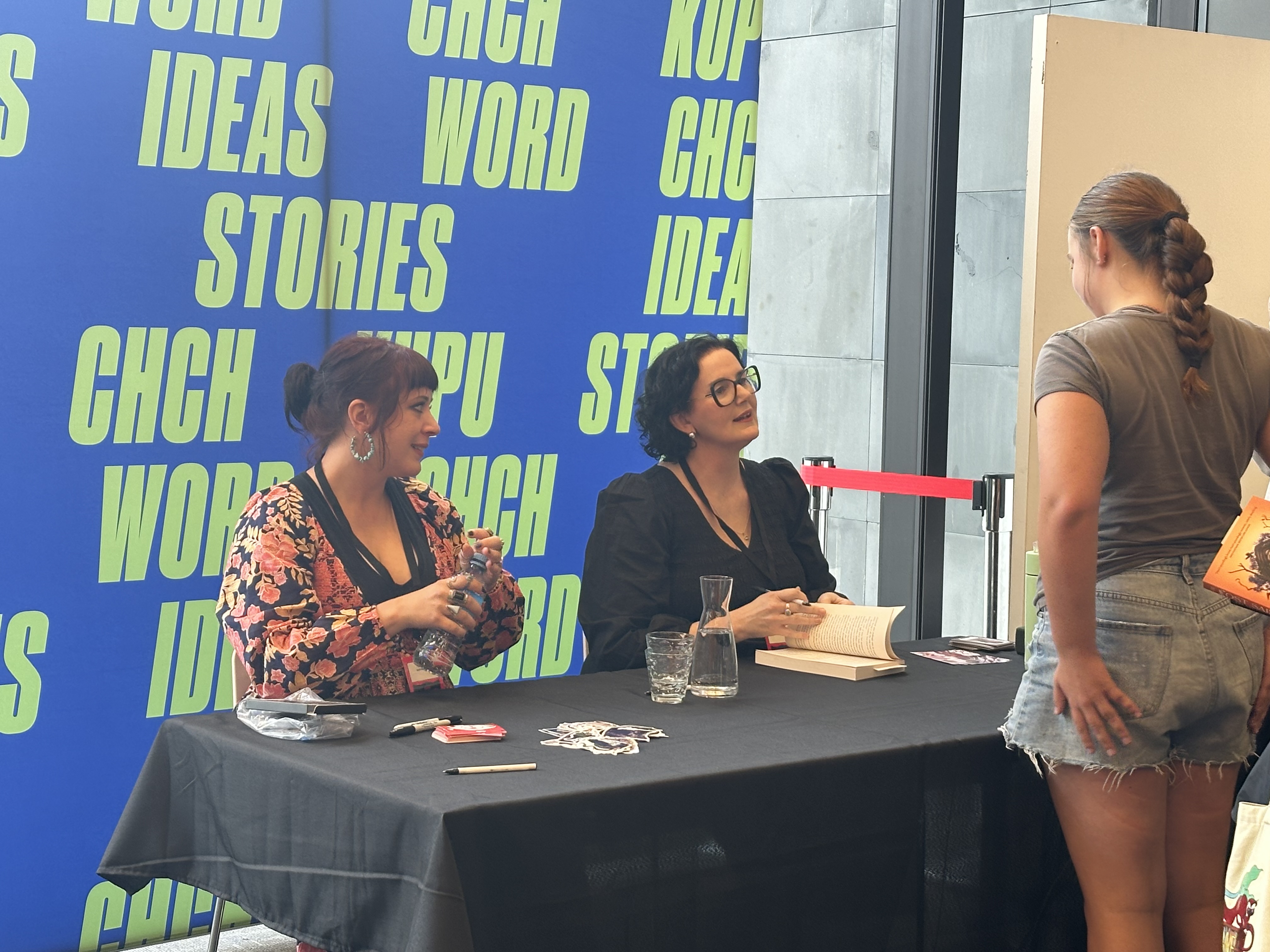
After the panel, Craw and Eames kindly signed books for fans... although A Harvest of Hearts is technically not published in physical form in New Zealand yet, so Eames instead signed slips that could be put into pre-purchased books when they arrive. She even added cute Cornelius stickers!
I'm so thrilled to have been able to hear these three brilliant women chat, and to get some insight from Andrea Eames and Rachael Craw into their novels. My reading journey for both A Harvest of Hearts and The Lost Saint was utterly enjoyable, and brought back a childlike feeling of magic. To experience that magic in a different way, hearing the love behind these stories and how they came to life, is all part of the joy of words. This session truly encapsulated what WORD Christchurch Festival is all about.
See more
- Find books by Andrea Eames in the catalogue
- Find books by Rachael Craw in the catalogue
- Check our fantasy reading guides
- Check our romance reading guides
WORD Christchurch
- WORD Christchurch website
- Follow WORD Christchurch on Instagram, Facebook and TikTok
- Our WORD Christchurch 2025 page - Find books by writers from this year's festival and check out our coverage of WORD events

Add a comment to: The Love Behind the Magic – The Romance of Fantasy at WORD Christchurch Festival 2025